Cassava
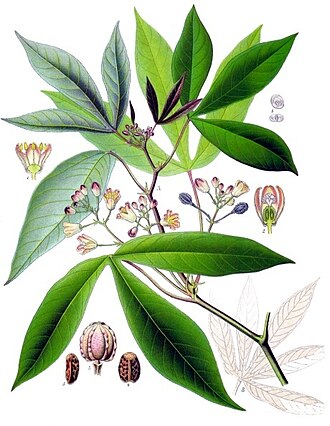
Manihot esculenta, commonly called cassava, manioc, or yuca, is a woody shrub of the spurge family, Euphorbiaceae, native to South America, from Brazil, Paraguay and parts of the Andes. Although a perennial plant, cassava is extensively cultivated in tropical and subtropical regions as an annual crop for its edible starchy tuberous root. Cassava is predominantly consumed in boiled form, but substantial quantities are processed to extract cassava starch, called tapioca, which is used for food, animal feed, and industrial purposes. The Brazilian farofa, and the related garri of West Africa, is an edible coarse flour obtained by grating cassava roots, pressing moisture off the obtained grated pulp, and finally drying and roasting it.
From Wikipedia, licensed under CC BY-SA 4.0
Research Mentions
Genome editing‑based strategies to combat geminiviruses: CRISPR/Cas...
Geminiviruses, spread by whiteflies, routinely wipe out tomato, pepper, and bean harvests — and C...
Phytomelatonin receptor PMTR1 is crucial for melatonin-mediated pla...
Cassava feeds over 800 million people worldwide, and this discovery could lead to disease-resista...
Crop biofortification for global food security: advances in genetic...
The rice, wheat, or corn in your pantry could soon be engineered to carry more iron, zinc, or vit...
Deciphering the Atlas of Protein Acetylation, 2-Hydroxyisobutyrylat...
Cassava feeds over 800 million people worldwide, and understanding how its roots build starch and...
Refocusing the study of human-plant relations to the genus scale: I...
Wild and semi-managed relatives of your garden taro are being selectively tended or uprooted by I...
Genome Editing in Root and Tuber Crop Development in Sub-Saharan Africa.
Cassava and sweet potato feed hundreds of millions of people in Africa, and the same gene-editing...
Enhanced spent oil bioremediation in contaminated soils using biost...
Soil fouled by motor oil or fuel spills can be coaxed back to life using kitchen and farm scraps ...
Repeatability and Heritability of UAV-Derived Canopy Traits in a Ca...
Cassava feeds over 800 million people across Africa and the tropics, and drone-based breeding too...
Gene silencing protects cassava from bacterial blight and streak virus
Cassava feeds roughly 800 million people across Africa, Asia, and Latin America, and two diseases...
Tropical crops hide genetic survival tricks scientists want to harness
The banana, cassava and palm oil in your kitchen all come from plants that survived brutal tropic...
Scientists find gene clues to herbicide-tolerant cassava plants
If you've ever watched a garden crop get scorched by drift from weed spray next door, this resear...
Four staple crops carry most of Asia's plant disease burden
If you've ever grown tomatoes, potatoes, or rice-adjacent grains, this review shows the same dise...
Combining resistant crops and pest control beats cassava's double v...
Cassava feeds hundreds of millions of people across Africa, and this model shows that planting re...
One genetic marker reliably predicts more nutritious cassava roots
Cassava feeds over half a billion people worldwide, often in regions where vitamin A deficiency i...
How bakers can swap in cassava flour for wheat
If you've ever grown cassava in a garden or tasted gluten-free baked goods made from root starche...
Cassava farming could fuel rural tourism in Angola
The humble root vegetable behind tapioca and fufu turns out to be a cultural anchor and potential...
Cassava farming could power rural tourism in Angola
The starchy root you might know from tapioca or cassava flour is, for over 200 farming households...


