Deciphering the Atlas of Protein Acetylation, 2-Hydroxyisobutyrylation, and Malonylation in Developing Cassava Roots.
Fu L, Yan Y, Huo K, Tie W, Yang J
Crop Improvement
Cassava feeds over 800 million people worldwide, and understanding how its roots build starch and handle stress could help breed hardier, more productive varieties — directly impacting food security for communities that depend on this crop.
Every protein in a plant can have tiny chemical tags attached to it that change how it works — like sticky notes that tell the protein to speed up, slow down, or do something different. Scientists found over 33,000 of these tags on thousands of proteins inside cassava roots, and mapped out which ones affect how the root stores starch or survives drought and disease. This is like getting the first complete instruction manual for how cassava roots grow and cope with the world around them.
Key Findings
Researchers identified 11,253 acetylation, 18,326 2-hydroxyisobutyrylation, and 4,068 malonylation modification sites across 5,165, 4,832, and 1,815 proteins respectively — the first atlas of its kind for cassava.
The majority of modified proteins were involved in starch and sugar metabolism, energy pathways, and lignin (woody tissue) production, with most proteins carrying more than one type of modification simultaneously.
Hundreds of modified proteins linked to stress response, hormone signaling, and gene regulation were identified, with some showing strong preferences for one specific type of chemical tag over others.
chevron_right Technical Summary
Scientists mapped thousands of chemical 'switches' on proteins inside growing cassava roots, revealing how these modifications control starch production, stress responses, and root development at a molecular level.
Abstract Preview
Lysine acetylation (Kac), 2-hydroxyisobutyrylation (Khib), and malonylation (Kma) represent three recently identified posttranslational modifications (PTMs) that regulate plant development and stre...
open_in_new Read full abstractAbstract copyright held by the original publisher.
Species Mentioned
Was this useful?
Want to tell us more? (optional)
Thanks for the note!
Something went wrong — please try again.
Too many submissions. Try again in an hour.
Targeted knockout of a host peroxisomal peptidase confers field resistance to...
The corn in your grocery store and the staple food keeping millions of East African families fed is under serious threat from a viral disease that can wipe o...
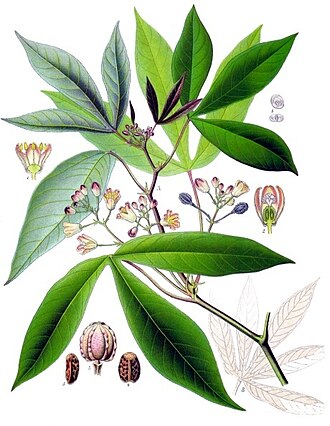
Manihot esculenta, commonly called cassava, manioc, or yuca, is a woody shrub of the spurge family, Euphorbiaceae, native to South America, from Brazil, Paraguay and parts of the Andes. Although a perennial plant, cassava is extensively cultivated in tropical and subtropical regions as an annual ...