Himalayan edible flower slows breast cancer cell growth
Dhungyal B, Ramachandran B, S B, Madhusoothanan S, Srinivas P
Medicinal Plants
A wild edible flower long used in Himalayan cooking turns out to have measurable biological activity against one of the hardest-to-treat cancers, a reminder that traditional food plants can hide real pharmacology worth studying rather than dismissing as folklore.
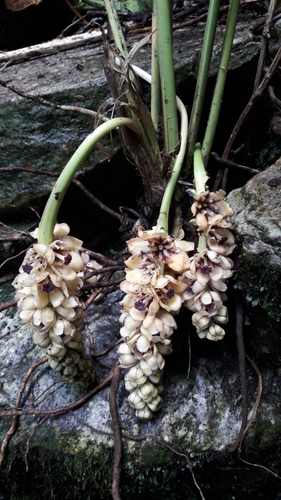
Tupistra nutans is a flowering plant from the Himalayas that people there already eat. Scientists tested its chemical extracts on breast cancer cells and found it slowed down and stopped the cancer cells from spreading, while leaving normal cells much less affected. Unlike many chemotherapy drugs, it didn't damage the cells' DNA, suggesting it works by putting cancer cells into a kind of standstill rather than killing them outright.
Key Findings
GC-MS analysis identified compounds like diosgenin, rhodopin, and 1,2-cyclopentanedione with predicted anti-cancer activity (apoptosis agonist, MMP9 inhibitor, myc inhibitor)
Extract showed selective toxicity: IC50 of 15.2 and 28.2 µg/mL in two triple-negative breast cancer lines (MDA-MB-231, HCC1937) versus 70.1 µg/mL in normal HEK-293T cells at 48 hours
Treatment reduced cancer cell migration without causing DNA damage (confirmed via γ-H2A.X and comet assay), while upregulating NBR2 and downregulating BRCA1, pointing to a cytostatic rather than apoptotic mechanism
chevron_right Technical Summary
Researchers found that extracts from Tupistra nutans, a flowering plant eaten in the Northeastern Himalayas, selectively slow the growth and movement of aggressive triple-negative breast cancer cells without damaging their DNA or harming normal cells as much.
Abstract Preview
Original paper
Phytochemical Characterization of Tupistra nutans Inflorescence and its Cytostatic and Anti-Migratory Effect in Breast Cancer Cells.
Breast cancer is one of the leading causes of cancer related mortality in women. Triple negative breast cancer (TNBC), characterized by the absence of ER, PR and HER2 receptors, is particularly cha...
open_in_new Read full abstractAbstract copyright held by the original publisher.
Species Mentioned
Was this useful?
Want to tell us more? (optional)
Thanks for the note!
Something went wrong — please try again.
Too many submissions. Try again in an hour.
Fifteen herbs from turmeric to lion's mane protect the aging brain
The saffron crocuses you plant in fall, the turmeric on a sunny windowsill, and the lemon balm spreading in your herb bed all contain compounds that clinical...
Ethnobotany is the interdisciplinary study of how humans use, manage, and perceive plants across different cultures, drawing on knowledge from botany, anthropology, ecology, and chemistry. It matters for plant science because it documents traditional ecological knowledge that can reveal previously
arrow_forward Explore topic