Leftover mushroom growing medium fights cucumber wilt disease
Qu Y, Liu X, Dong L, Su Z, Bouwmeester H
Soil Health
If you've ever lost a cucumber patch to sudden wilting, the compost pile at your local mushroom farm might hold a cheap, natural fix that protects the good bacteria your soil needs.
A fungus that causes cucumber wilt releases a poison called fusaric acid that hurts the plant and kills off the helpful bacteria living in the soil around its roots. Researchers found that spent mushroom substrate, the leftover growing material from mushroom farms, can trap that poison like a sponge before it reaches the roots. Adding a small amount of this waste material to soil reduced wilt disease by up to 26% and helped protect a beneficial bacterium called Bacillus that normally gets wiped out by the toxin.
Key Findings
Spent mushroom substrate adsorbed fusaric acid with a maximum capacity of 52.72 μg/g, binding via secondary amide groups identified through infrared spectroscopy
1% spent mushroom substrate cut fusaric acid reaching cucumber roots by roughly 75-80% across low, medium, and high toxin exposure levels
In real (nonsterile) soil, the substrate reduced disease severity by 19-26% and helped preserve Bacillus bacteria levels (2.96% vs. 2.19% without treatment) that the toxin normally suppresses
chevron_right Technical Summary
Mushroom farm waste can soak up a toxin that Fusarium fungus uses to kill cucumber plants and wreck the beneficial bacteria living around their roots. Adding just 1% spent mushroom substrate to soil cut fungal wilt disease by up to a quarter.
Abstract Preview
Original paper
Spent mushroom substrate adsorbs fusaric acid to protect the cucumber rhizosphere microbiome and suppress fusarium wilt caused by Fusarium oxysporum f. sp. cucumerinum.
Cucumber Fusarium wilt, caused by Fusarium oxysporum f. sp. cucumerinum, is aggravated by fusaric acid, a phytotoxic virulence factor that can disrupt rhizosphere microbial communities. Spent mushr...
open_in_new Read full abstractAbstract copyright held by the original publisher.
Species Mentioned
Was this useful?
Want to tell us more? (optional)
Thanks for the note!
Something went wrong — please try again.
Too many submissions. Try again in an hour.
Targeted knockout of a host peroxisomal peptidase confers field resistance to...
The corn in your grocery store and the staple food keeping millions of East African families fed is under serious threat from a viral disease that can wipe o...
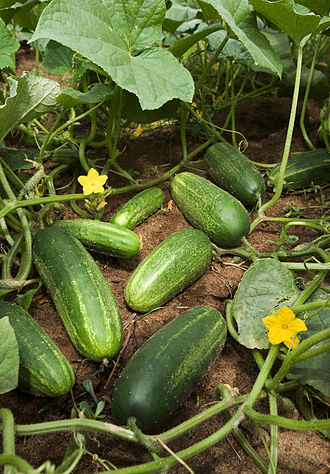
The cucumber is a widely-cultivated creeping vine plant in the family Cucurbitaceae that bears cylindrical to spherical fruits, used as culinary vegetables. Considered an annual plant, there are three main types of cucumber—slicing, pickling, and seedless.