Cassava farming could power rural tourism in Angola
Ethnobotany
The starchy root you might know from tapioca or cassava flour is, for over 200 farming households studied here, the backbone of food security, cash income, and cultural identity all at once, showing how one adaptable crop can anchor an entire rural economy.
Researchers talked to 221 cassava-growing families in Angola along with local traditional leaders and government officials to understand what this one crop really means to rural life. It turns out cassava isn't just dinner: it puts money in farmers' pockets, keeps traditional recipes and customs alive, and could draw visitors interested in authentic farm-to-table food experiences. The team built a model showing how family farming, cultural heritage, and local resources can work together to boost both rural development and tourism.
Key Findings
Surveyed 221 family farming households plus interviews with traditional leaders (Sobas and Regedores) and provincial planning officials in Malanje Province, Angola
Cassava strengthens food security, generates household income, and reinforces local cultural identity through traditional food products
Researchers proposed an integrated conceptual model linking family farming, sustainable livelihoods, territorial development, and rural tourism, tied to SDGs 1, 2, 8, 11, 12, and 15
chevron_right Technical Summary
A study of 221 farming families in Angola's Malanje Province found that growing cassava does far more than feed people; it generates income, preserves cultural traditions, and could become a foundation for rural tourism built around traditional food heritage.
Abstract Preview
Original paper
Contribution of Cassava Cultivation to Farmers' Livelihoods in Malanje Province, Angola: Implications for Territorial Development and Rural Tourism
Cassava cultivation plays a fundamental role in food security, income generation, and the livelihoods of rural communities across Sub-Saharan Africa. However, empirical evidence on its contribution...
open_in_new Read full abstractAbstract copyright held by the original publisher.
Species Mentioned
Was this useful?
Want to tell us more? (optional)
Thanks for the note!
Something went wrong — please try again.
Too many submissions. Try again in an hour.
Targeted knockout of a host peroxisomal peptidase confers field resistance to...
The corn in your grocery store and the staple food keeping millions of East African families fed is under serious threat from a viral disease that can wipe o...
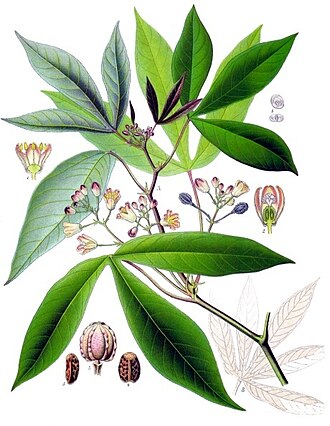
Manihot esculenta, commonly called cassava, manioc, or yuca, is a woody shrub of the spurge family, Euphorbiaceae, native to South America, from Brazil, Paraguay and parts of the Andes. Although a perennial plant, cassava is extensively cultivated in tropical and subtropical regions as an annual ...