Repeatability and Heritability of UAV-Derived Canopy Traits in a Cassava Breeding Population Using Time-Series Data from Two Consecutive Growing Seasons
Quiros-Vargas, J.; van Doorn, A.; Rabbi, I. Y.; Piepho, H.-P.; Bendig, J.; Zierer, W.; Sonnewald, U.; Rascher, U.; Muller, O.
Crop Improvement
Cassava feeds over 800 million people across Africa and the tropics, and drone-based breeding tools could help develop more productive varieties faster, potentially stabilizing food supplies for communities that depend on it as a daily staple.
Researchers flew drones over cassava fields twice a year for two growing seasons, measuring how tall and bushy each plant variety grew. They found that how big a plant gets is strongly controlled by its genes, while how fast it grows week-to-week is more influenced by weather and season. This means breeders can use drone photos to reliably pick the best-performing cassava varieties without spending years doing slow, manual measurements.
Key Findings
Canopy height and volume showed moderate-to-high heritability (H² = 0.58 and 0.64), meaning genetics strongly controls final plant size — making these traits useful for selecting superior varieties.
Repeatability was high for all UAV-derived traits (R = 0.68–0.69), confirming that drone measurements are reliable and consistent across seasons and plot replicates.
Relative growth rates had near-zero heritability, indicating they are driven mainly by environmental conditions rather than genetics — useful for studying stress response but not for variety selection.
chevron_right Technical Summary
Scientists used camera-equipped drones to measure how cassava plants grow in Nigerian fields over two years, finding that canopy height and volume reliably reflect genetic differences between varieties — making drones a practical tool to speed up cassava breeding.
Abstract Preview
Cassava is a major staple crop in tropical regions, particularly in Sub-Saharan Africa, yet its productivity remains constrained by genetic and agronomic limitations. A major bottleneck in cassava ...
open_in_new Read full abstractAbstract copyright held by the original publisher.
Species Mentioned
Was this useful?
Want to tell us more? (optional)
Thanks for the note!
Something went wrong — please try again.
Too many submissions. Try again in an hour.
Gene editing removes 97% of celiac-triggering proteins from bread wheat
It could mean that people with celiac disease — roughly 1 in 100 worldwide — may one day safely eat bread made from real wheat, without sacrificing the taste...
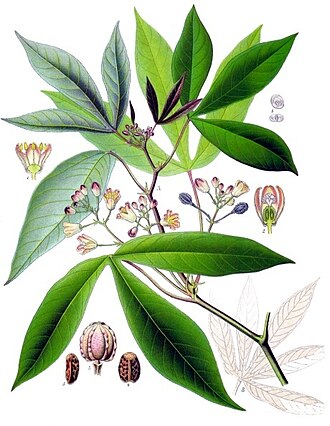
Manihot esculenta, commonly called cassava, manioc, or yuca, is a woody shrub of the spurge family, Euphorbiaceae, native to South America, from Brazil, Paraguay and parts of the Andes. Although a perennial plant, cassava is extensively cultivated in tropical and subtropical regions as an annual ...