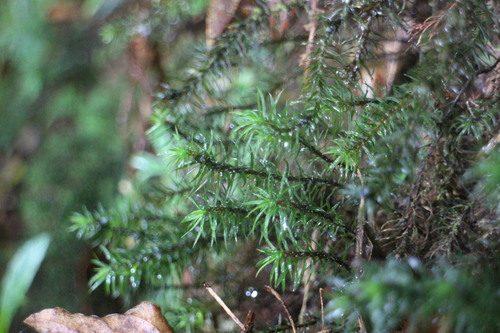
Plant family
Polytrichaceae is a common family of mosses. Members of this family tend to be larger than other mosses, with the larger species occurring in particularly moist habitats. The leaves have specialized sheaths at the base and a midrib that bears photosynthetic lamellae on the upper surface. These mosses are capable of sustaining high rates of photosynthesis in the presence of ample light and moisture. Unlike all other mosses, the hydroid-based vascular system of these mosses is continuous from stem to leaf and can extract water from the soil through transpiration. Species in this group are dioicous, though some are monoicous. In most species, the sporophytes are relatively large, the setae are rigid, and the calyptrae are hairy. Most species have nematodontous peristomes with 32–64 teeth in their sporangium; some early-diverging genera instead have a stopper mechanism, which consists of the apical section of the columella, that seals the mouth of the capsule shut prior to dehiscence.
From Wikipedia,
licensed under CC BY-SA 4.0