Interactions of nitrogen sources and foliar biostimulants differentially regulate photosynthetic efficiency and seed yield of cluster bean (Cyamopsis tetragonoloba L.) under semi-humid and arid climates.
Rahimi-Moghaddam S, Rashidi Z, Davarpanah SJ, Azizi K, Eyni-Nargeseh H
Crop Improvement
The plant tonic and fertilizer combo you use in your garden could be remarkably effective or nearly useless depending on your local climate — and this study pinpoints which pairings actually deliver bigger harvests in dry versus humid conditions.
Scientists tested whether spraying bean plants with natural boosting compounds—like a relative of aspirin, vitamin C, and a soil extract called humic acid—while feeding them different nitrogen fertilizers could improve growth and bean production. They ran the experiment in two very different climates in Iran, one dry and one more humid, and found that the same treatment didn't perform the same way in both places. This means farmers and gardeners need to match their fertilizer and plant-boost strategy to the climate they're actually growing in.
Key Findings
Combinations of nitrogen source and foliar biostimulant (humic acid, salicylic acid, or ascorbic acid) significantly affected both photosynthetic efficiency and seed yield in cluster bean.
Climate strongly moderated treatment outcomes — the semi-humid site (Khorramabad) and the arid site (Mashhad) produced measurably different responses to the same nitrogen-biostimulant pairings.
Five nitrogen treatments were compared (including a zero-nitrogen control and urea at 69 kg N/ha), revealing that no single combination was universally optimal across both climatic conditions.
chevron_right Technical Summary
Spraying cluster bean plants with natural compounds like humic acid, salicylic acid, or ascorbic acid—combined with different nitrogen fertilizers—boosts photosynthesis and seed yield, but how well these combinations work depends heavily on whether crops are grown in a humid or arid climate.
Abstract Preview
Biostimulants such as humic acid (HA), salicylic acid (SA), and ascorbic acid (ASA) have gained increasing attention for enhancing crop resilience and productivity. However, their effectiveness is ...
open_in_new Read full abstractAbstract copyright held by the original publisher.
Species Mentioned
Was this useful?
Want to tell us more? (optional)
Thanks for the note!
Something went wrong — please try again.
Too many submissions. Try again in an hour.
Targeted knockout of a host peroxisomal peptidase confers field resistance to...
The corn in your grocery store and the staple food keeping millions of East African families fed is under serious threat from a viral disease that can wipe o...
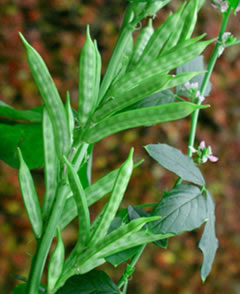
The guar or cluster bean, with the botanical name Cyamopsis tetragonoloba, is an annual legume and the source of guar gum. It is also known as gavar, gawar, or guvar bean. The genus name Cyamopsis means bean-like. The specific name is from Greek: τετράγωνον, romanized: tetrágōnon and Latin: lobu...