This sorghum gene helps plants shrug off salty soil
Chen Z, Chen S, Ding Y, Yang W, Lu J
Crop Improvement
If you've ever watched plants struggle near a salted sidewalk or in coastal soil, this gene points to a natural toolkit breeders could use to grow tougher crops in those same tough spots.
Sorghum, a hardy grain crop, carries a family of 21 genes that act like switches for stress and growth. Researchers found one switch, SbTIFY9, that flips on strongly when the plant senses salty water, ramping up 10-fold within half a day and over 30-fold by the next day. When they put that same gene into a different test plant, it grew stronger roots and leaves even when soaked in salt water, showing this single gene can make plants more salt-tolerant.
Key Findings
Identified 21 TIFY family genes in sorghum, grouped into JAZ and ZML subfamilies based on protein structure and phylogeny
SbTIFY9 transcript levels rose approximately 10-fold at 12 hours and 31-fold at 24 hours of salt treatment
Overexpressing SbTIFY9 in Arabidopsis improved leaf expansion, seedling fresh weight, and root growth under 125 and 150 mM NaCl salt stress
chevron_right Technical Summary
Scientists mapped all 21 genes in sorghum's TIFY family, a group of plant stress-response regulators, and found that one gene called SbTIFY9 helps plants tolerate salty soil. When they added this gene to lab plants, the plants grew bigger roots and leaves under salt stress than normal plants did.
Abstract Preview
Original paper
Genome-wide identification of the TIFY gene family in Sorghum bicolor and functional characterization of SbTIFY9 in salt stress tolerance.
The TIFY gene family is a plant-specific group of transcriptional regulators characterized by a conserved TIFY domain (TIF[F/Y]XG), participating in plant development, phytohormone signaling and ab...
open_in_new Read full abstractAbstract copyright held by the original publisher.
Species Mentioned


Was this useful?
Want to tell us more? (optional)
Thanks for the note!
Something went wrong — please try again.
Too many submissions. Try again in an hour.
Targeted knockout of a host peroxisomal peptidase confers field resistance to...
The corn in your grocery store and the staple food keeping millions of East African families fed is under serious threat from a viral disease that can wipe o...
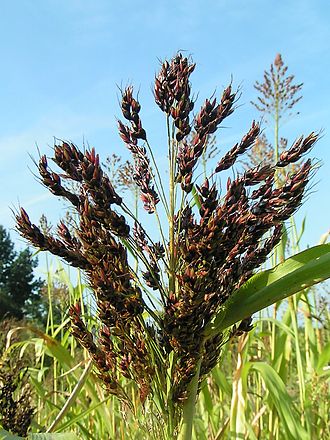
Sorghum bicolor, commonly called sorghum and also known as broomcorn, great millet, Indian millet, Guinea corn, jowar, or milo, is a species in the grass genus Sorghum. It is typically an annual, but some cultivars are perennial. It grows in clumps that may reach over 4 metres (13 ft) high. The g...