A single gene keeps sorghum's water pipes from collapsing in heat
Liu Z, Tian R, D'Agostino L, Xin Z, Chen J
Climate Adaptation
Ornamental grasses, corn, and sorghum all rely on the same kind of internal plumbing, and leaf scorch on a hot afternoon can signal that water isn't moving fast enough through it, not just that the soil is dry.
Sorghum is a tough grass that grows in hot, dry places, but it only works if its tiny water pipes stay open and sturdy. Researchers found a gene that helps build the reinforced walls of the first pipes in young leaves. Without it, the pipes collapsed, water couldn't reach the leaf tips fast enough, and the leaves scorched in the field.
Key Findings
The hs1 mutant sorghum showed severe leaf scorching in the field, with collapsed protoxylem vessels, reduced lumen area, and weaker lignified cell walls under controlled conditions.
Impaired protoxylem reduced longitudinal hydraulic conductance and whole-plant water use, so developing leaves couldn't meet transpirational demand, causing transient water deficit and tissue injury.
HS1 is a grass-specific myosin VIII expressed in differentiating protoxylem cells and needed for proper lignin deposition; low nucleotide diversity at the locus suggests strong evolutionary constraint.
chevron_right Technical Summary
Scientists found a gene in sorghum that builds the strong water pipes leaves need to survive heat. Plants missing it had collapsed pipes, couldn't move enough water, and their leaves scorched in the field.
Abstract Preview
Original paper
A Grass-Specific Structural Myosin VIII Regulates Protoxylem Development and Hydraulic Conductance in Sorghum.
Sorghum (Sorghum bicolor), a C4 grass adapted to hot semi-arid environments, depends on reinforced xylem vessels to maintain hydraulic conductance under high evaporative demand. During xylem differ...
open_in_new Read full abstractAbstract copyright held by the original publisher.
Species Mentioned
Was this useful?
Want to tell us more? (optional)
Thanks for the note!
Something went wrong — please try again.
Too many submissions. Try again in an hour.
Targeted knockout of a host peroxisomal peptidase confers field resistance to...
The corn in your grocery store and the staple food keeping millions of East African families fed is under serious threat from a viral disease that can wipe o...
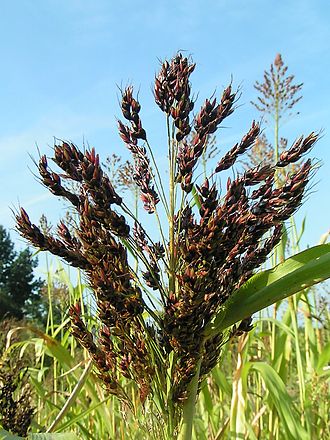
Sorghum bicolor, commonly called sorghum and also known as broomcorn, great millet, Indian millet, Guinea corn, jowar, or milo, is a species in the grass genus Sorghum. It is typically an annual, but some cultivars are perennial. It grows in clumps that may reach over 4 metres (13 ft) high. The g...