Scientists find gene clues to herbicide-tolerant cassava plants
Santiago RT, Souza MBE, Cortes DFM, de Oliveira EJ
Crop Improvement
If you've ever watched a garden crop get scorched by drift from weed spray next door, this research is aimed at breeding staple food plants tough enough to shrug that off.
Cassava is a major food crop for millions of people, but the herbicides farmers use to kill weeds can also hurt the cassava plants themselves. Researchers tested 194 different cassava varieties against three weed killers and tracked how much damage showed up over time, then used genetic mapping to find the specific spots in cassava's DNA linked to better tolerance. They found several candidate genes involved in things like moving chemicals across cell membranes and cell signaling, which breeders could eventually use to select hardier cassava varieties.
Key Findings
GWAS across 194 cassava genotypes identified genomic regions on chromosomes 2, 9, and 15 linked to tolerance of three herbicides (mesotrione, S-metolachlor, chloransulam-methyl)
Phytotoxicity symptoms were most distinguishable between genotypes at 9 days after herbicide application, making this the key phenotyping timepoint
Candidate genes point to membrane transport, protein phosphorylation/signaling, and methyltransferase activity as likely mechanisms behind herbicide tolerance, which the study describes as a polygenic trait controlled by many small-effect loci
chevron_right Technical Summary
Scientists scanned the genomes of 194 cassava varieties and found specific gene regions linked to how well the plants tolerate common weed-killing chemicals, opening a path to breed cassava that survives herbicide spraying without damage.
Abstract Preview
Original paper
Pinpointing genomic regions conferring herbicide tolerance in cassava via genome-wide association mapping.
Cassava (Manihot esculenta Crantz) is a tropical crop of major socioeconomic importance, whose productivity can be limited by sensitivity to herbicides used for weed management. This study aimed to...
open_in_new Read full abstractAbstract copyright held by the original publisher.
Species Mentioned
Was this useful?
Want to tell us more? (optional)
Thanks for the note!
Something went wrong — please try again.
Too many submissions. Try again in an hour.
Targeted knockout of a host peroxisomal peptidase confers field resistance to...
The corn in your grocery store and the staple food keeping millions of East African families fed is under serious threat from a viral disease that can wipe o...
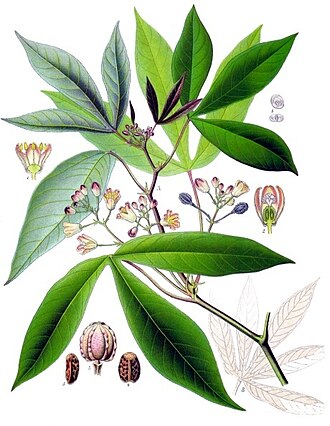
Manihot esculenta, commonly called cassava, manioc, or yuca, is a woody shrub of the spurge family, Euphorbiaceae, native to South America, from Brazil, Paraguay and parts of the Andes. Although a perennial plant, cassava is extensively cultivated in tropical and subtropical regions as an annual ...