One genetic marker reliably predicts more nutritious cassava roots
Crop Improvement
Cassava feeds over half a billion people worldwide, often in regions where vitamin A deficiency is common, so a genetic shortcut to breeding more nutritious, less toxic varieties could mean healthier meals without years of trial-and-error crossbreeding.
Cassava is a root vegetable that's a major food source in many parts of the world, but wild and traditional varieties can be low in nutrients and contain natural cyanide compounds that need careful processing to remove. Breeders want to use genetic markers, like molecular flags in the plant's DNA, to quickly identify which young plants will grow up with more vitamin A, better texture, and less cyanide, without waiting years to see how they turn out. This study tested nine of these DNA markers on hundreds of real cassava plants and found one marker that consistently worked for boosting vitamin A content, while the markers for the other traits were less reliable and behaved differently depending on which cassava population was tested.
Key Findings
Marker S1_24155522 showed a strong, consistent association with total carotenoid content (vitamin A precursor) across breeding populations, making it the most promising candidate for marker-assisted selection
Genotyping was highly reliable, with call rates exceeding 96% and clear allelic discrimination across 360 tested genotypes from two independent breeding populations
The relationship between carotenoid and dry matter content flipped direction between populations (r = -0.26 in one, r = +0.37 in the other), showing dry matter and cyanide markers are less reliable due to complex genetics
chevron_right Technical Summary
Scientists tested nine genetic markers meant to help breed better cassava, a staple food crop for hundreds of millions of people, and found that one marker reliably predicts higher levels of beta-carotene, an important nutrient, while markers for other traits worked inconsistently across different cassava populations.
Abstract Preview
Original paper
Validation of single nucleotide polymorphism markers associated with hydrogen cyanide, total carotenoid and dry matter contents in cassava (Manihot esculenta Crantz)
Enhancing total carotenoid content (TCC) and dry matter content (DMC) while simultaneously reducing hydrogen cyanide (HCN) are key objectives in cassava breeding. Although numerous SNP markers have...
open_in_new Read full abstractAbstract copyright held by the original publisher.
Species Mentioned
Was this useful?
Want to tell us more? (optional)
Thanks for the note!
Something went wrong — please try again.
Too many submissions. Try again in an hour.
Targeted knockout of a host peroxisomal peptidase confers field resistance to...
The corn in your grocery store and the staple food keeping millions of East African families fed is under serious threat from a viral disease that can wipe o...
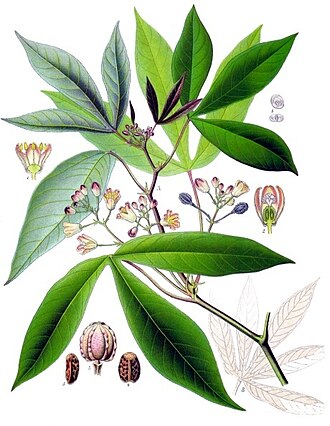
Manihot esculenta, commonly called cassava, manioc, or yuca, is a woody shrub of the spurge family, Euphorbiaceae, native to South America, from Brazil, Paraguay and parts of the Andes. Although a perennial plant, cassava is extensively cultivated in tropical and subtropical regions as an annual ...