Combining resistant crops and pest control beats cassava's double virus threat
Crop Improvement
Cassava feeds hundreds of millions of people across Africa, and this model shows that planting resistant varieties alone won't stop the disease if farmers ignore the whiteflies spreading it between plants.
Cassava, a root crop that's a dietary staple across Africa, can get infected by two different mosaic viruses at once, and that double-infection is worse than either virus on its own. Researchers built a math model tracking how the viruses spread between plants and the whiteflies that carry them, then tested which combinations of solutions (resistant plant varieties, clean planting material, better farming practices, and killing off whiteflies) actually stop the spread. The answer: no single fix works well, but stacking resistant varieties with vector control knocks infection rates down dramatically.
Key Findings
The co-infection model's basic reproduction number exceeds that of either single-virus model, meaning combined infections spread more persistently and severely than one virus alone
Disease can be eradicated when the reproduction number stays below one, and the model is both locally and globally stable in that scenario
Combining resistant cassava varieties with whitefly vector removal substantially outperforms either strategy alone in simulations, pushing infection levels down and keeping the reproduction number under one
chevron_right Technical Summary
Scientists built a mathematical model showing that when two viruses infect cassava plants together, the disease spreads faster and lasts longer than either virus alone, but combining resistant crop varieties with whitefly control can drive infections down to nearly zero.
Abstract Preview
Original paper
Mathematical model analysis for dynamics and control of African cassava mosaic virus and East African cassava mosaic Cameroon virus co-infections
Introduction Cassava is a key staple crop in many developing countries but is severely affected by African cassava mosaic virus (ACMV) and East African cassava mosaic Cameroon virus (EACMCMV). Co-i...
open_in_new Read full abstractAbstract copyright held by the original publisher.
Species Mentioned
Was this useful?
Want to tell us more? (optional)
Thanks for the note!
Something went wrong — please try again.
Too many submissions. Try again in an hour.
Gene editing removes 97% of celiac-triggering proteins from bread wheat
It could mean that people with celiac disease — roughly 1 in 100 worldwide — may one day safely eat bread made from real wheat, without sacrificing the taste...
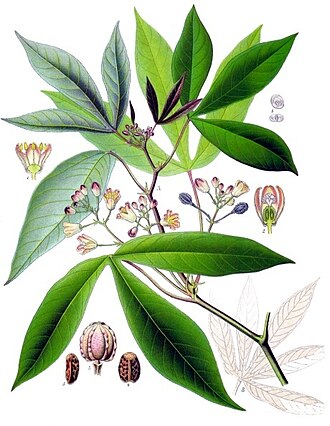
Manihot esculenta, commonly called cassava, manioc, or yuca, is a woody shrub of the spurge family, Euphorbiaceae, native to South America, from Brazil, Paraguay and parts of the Andes. Although a perennial plant, cassava is extensively cultivated in tropical and subtropical regions as an annual ...